Full Story Here 👇
“My father stole my Lake Tahoe villa and gave it to my sister’s family, sneering, “Go back to your base, Commander. You’re not welcome here.” I smiled, picked up my duffel bag, and left, because before they moved in, I had already turned their dream home into the beginning of their worst nightmare.
The champagne cork burst above me just as my military duffel bag landed on the marble floor.
I had driven straight to Lake Tahoe after three sleepless weeks of naval exercises, still in uniform, my shoulders aching and my eyes burning from exhaustion.
I had expected silence.
A hot shower.
One peaceful night in the only place that had ever truly felt like mine.
Instead, I found my father, Olivia, Susan, and David acting as if my home had already become theirs.
Dad looked down at me and said, “This villa is too big for one person. Olivia has a husband and children. They need it more than you do.”
“This is my house.”
His mouth twisted.
“Go back to your base, Commander. You’re not welcome here.”
Olivia raised her champagne glass.
She looked victorious.
That was the moment I understood they had mistaken my discipline for surrender.
They had forgotten the SUV I bought Olivia.
The money I wired when Dad claimed creditors were threatening him.
The $50,000 I handed over after burying my husband, James, because Dad said the family home was in danger.
More than $110,000.
And now they were celebrating inside the villa I had bought with what remained of my savings.
So I picked up my duffel bag.
“All right,” I said.
Dad expected an argument.
Olivia expected tears.
Instead, I walked out.
Behind me, another champagne cork popped.
By the time I reached my truck, they had already forgotten I was there.
That was their mistake.
The following morning, I placed every document connected to the villa on my desk at the San Diego naval base.
The deed.
The insurance records.
The tax payments.
The renovation invoices.
Every page carried my name.
Then I called Michael Vance, a former military attorney.
“I need to protect a property.”
“From whom?”
“My family.”
My next call was to Ethan Wright, a former naval electronic-warfare officer and one of the most resourceful people I knew.
“My family has decided to occupy my Lake Tahoe villa,” I told him.
“Do they have permission?”
“No.”
“Do they think they do?”
“Completely.”
“That makes them predictable.”
Over the next several days, Michael prepared the formal notices and closed every legal opening my father might try to exploit.
Then Olivia called.
At first, she cried.
“The children need space.”
Then she blamed my father’s blood pressure on me.
Then, when I stayed silent, her voice changed.
“We’re moving in Sunday. Dad said you can’t stop us.”
“Try it,” I said.
Sunday afternoon, I watched the villa’s exterior cameras from my apartment.
The SUV I had bought Olivia rolled into my driveway.
Dad stepped out first.
Susan followed.
Then Olivia and David began unloading boxes, toys, suitcases, and framed family photographs.
They were not visiting.
They intended to erase me.
At the front door, they found Michael’s formal notice.
Private property. Unauthorized entry prohibited. Automated security active. Contact the registered owner before entering.
Susan tore it down.
Dad laughed.
“She’s throwing another tantrum.”
David used the spare key.
The door opened.
They dragged their belongings inside.
I watched from three hundred miles away, perfectly calm.
Beside my laptop sat a sealed legal folder, an encrypted phone, and one final document bearing my signature.
My father believed he had taken my villa.
Olivia believed she had inherited a luxury home.
But they had never checked whether Dad had the legal authority to give away property that wasn’t his.
And they had no idea that, before they crossed that threshold, I had already changed the conditions under which anyone could remain there.
→
By nightfall, they had finished unpacking their lives into my sanctuary. From the dashboard on my screen, I watched them pop another bottle of wine in the chef’s kitchen. David had already put his feet up on the imported cedar coffee table. Olivia was wandering through the primary suite, running her fingers along the heated marble countertops, pointing out which furniture she planned to sell.
They assumed that possession was nine-tenths of the law.
What they failed to understand was that Ethan Wright didn’t just build commercial firewalls; he automated high-security infrastructure. The villa wasn’t just a luxury lodge; it was wired with enterprise-grade, encrypted military firmware.
At exactly 9:00 PM, I sent Ethan a single prompt: Initiate Phase One.
“”Executing,”” Ethan replied.
In Lake Tahoe, the lights didn’t go out. That would have been too simple. Instead, the smart-home automation began its predetermined lockdown protocol.
First went the digital climate control. In the dead of late autumn Tahoe mountain air, the geothermal radiant heating shut down entirely. The auxiliary vents switched to maximum ventilation, pulling freezing thirty-two-degree alpine air directly into the vaulted living room.
On camera, I watched Susan shiver, pulling her knit cardigan tight around her shoulders. David marched toward the digital wall panel and furiously tapped the glass touchscreen.
A stark, white prompt greeted his fingers:
ACCESS DENIED. ADMINISTRATIVE OVERRIDE REQUIRED. GUEST OCCUPANCY UNVERIFIED.
David tried to force the gas fireplace on. It remained dead; Ethan had closed the digital intake valves remotely.
Then, the water pressure dropped to zero. Olivia turned the faucet in the kitchen sink to wash her wine glass, only to hear the metallic hiss of dry copper pipes.
Within minutes, my phone began ringing.
It was Dad.
I tapped speakerphone, setting the device beside my untouched cup of black coffee.
“”Commander,”” his voice boomed, frantic and ragged. “”What did you do to the utilities? Turn the heat back on! Your mother is freezing, and the kids can’t even brush their teeth!””
“”I don’t own utilities at a private residence anymore, Richard,”” I said, voice completely flat. “”Didn’t you tell me to go back to my base?””
“”Stop this childish nonsense right now!”” he barked, trying to muster his old, thunderous authority. “”This is a family home! We have rights! We’re established here now!””
“”Check your email, Richard. And Olivia’s. Michael Vance just served your copies.””
There was a muffled scuffle on the other end, followed by the faint rustling of Olivia opening her laptop. A moment of silence hung in the air—cold, heavy, and paralyzing.
What they found wasn’t an eviction notice that could be fought over months in tenant court. They were never tenants, and they had never paid rent.
Instead, three days prior, I had transferred the physical real estate into a blind commercial trust managed by an institutional asset firm—and signed a binding, fully insured commercial lease agreement with a high-profile corporate security firm specializing in cold-weather wilderness retreats.
My family hadn’t walked into an empty home. They had broken into a commercial site currently under active commercial contract.
Buried in that contract was an explicit clause: Immediate civil damages of $2,500 per day for unauthorized civilian trespass, plus legal fees, accrued immediately upon digital perimeter breach.
Furthermore, Michael had filed an emergency financial lien on the SUV sitting in the driveway. The title was in my name; Olivia was merely a permitted driver. The moment she signed the affidavit claiming she intended to establish residency without my permission, she breached the vehicle’s custody terms. A private repossession transport was already climbing the mountain pass.
“”You… you leased it out?!”” Olivia shrieked through the receiver, snatching the phone from Dad. “”To a corporation?! Where are we supposed to go?! We gave up our apartment in Reno! We gave up our lease because Dad said this was ours!””
“”You should have asked the person holding the deed,”” I replied.
“”You’re a monster, Claire!”” Susan’s shrill voice cried out from the background. “”Your own blood! We’re your family!””
“”Family doesn’t extort a widow for fifty grand at her husband’s funeral,”” I said, every word clipped and hard as iron. “”Family doesn’t abandon a recovering officer on a freezing curb with twelve dollars and an open incision. You wanted to celebrate your victory. Enjoy the house.””
I hung up and blocked all four numbers.
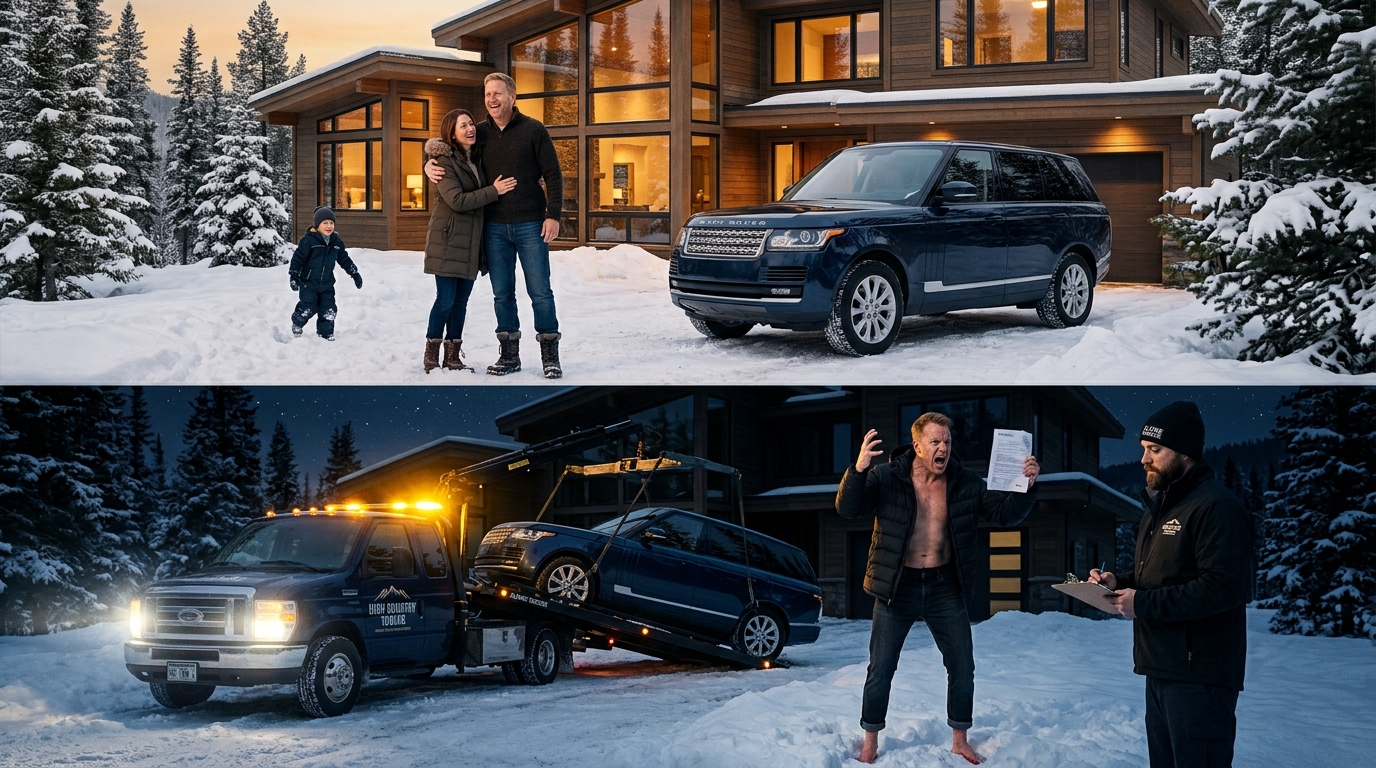
At 10:15 PM, the perimeter cameras showed the heavy, dual-axle flatbed tow truck rumble up the private drive. Two armed private security contractors stepped out into the crisp mountain air, accompanied by a repossession specialist who hooked Olivia’s beloved SUV without a moment’s hesitation.
David came charging out the front door in his socks, screaming obscenities into the freezing wind, waving his arms hysterically. The lead security agent calmly held up a laminated court order and an asset recovery warrant, never once stepping backward. David looked at the mountain snow stinging his bare feet, looked at his family’s luggage piled inside the freezing house, and stopped dead in his tracks.
Inside the house, the power did not return. The heat stayed dead. The locks on every interior bedroom snapped shut in automated fail-safe mode, leaving them huddled in the cold, cavernous front foyer beneath the high, empty rafters.
By dawn, they were gone.
The cameras recorded them hauling their mismatched cardboard boxes, damp coats, and crying children into a pair of expensive alpine taxis they could barely afford, their grand celebration reduced to shivering defeat on the mountain shoulder.
I closed my laptop, zipped my duffel bag, and stood up straight. For the first time in years, the weight on my shoulders wasn’t exhaustion.