
“I asked my banker daughter for just $100.
Her answer told me everything I needed to know.
“You already live here for free,” Lucille snapped. “If you want money, go get a job, you leech!”
She had no idea that the very next morning, I would walk into her bank carrying papers worth $260 million.
And when she finally saw the number, her face went white.
But by then, it was already too late.
The morning before, Edna Morrison had been standing quietly in her daughter’s spotless kitchen, one hand nervously twisting the wedding ring she still wore three years after burying her husband, Harold.
She hadn’t asked for much.
Just $100.
Lucille set her coffee mug on the granite counter so hard that Edna flinched.
“You already live here for free,” Lucille said, folding her arms over her perfectly pressed bank uniform. “Food, utilities, everything. And now you want cash too?”
Edna stared at her only daughter.
She had moved into Lucille’s house after Harold died, but she had done everything possible not to become a burden. She bought her own groceries whenever she could. She washed her own clothes, cleaned her small bedroom, helped around the house, and rarely asked Lucille for anything.
Today was supposed to be different.
A neighbor had told Edna about a small craft fair happening that weekend. Edna’s Social Security check wouldn’t arrive for several more days, so she thought asking Lucille for a temporary loan would be harmless.
She planned to repay every dollar.
Instead, Lucille looked at her as though she had demanded thousands.
“You’re sixty-two, Mom, not ninety-two,” she said coldly. “If you want money, go get a job.”
Heat rushed into Edna’s cheeks.
For a moment, memories flooded back.
Years spent hunched over a sewing machine.
Double shifts.
Carefully counted grocery money.
Nights when she told Lucille she wasn’t hungry so her little girl could have enough to eat.
School clothes.
Books.
Tuition.
Every sacrifice she and Harold had made so their daughter could build a better life.
“I’ve never asked you for anything like this before,” Edna said softly.
“That’s not the point.”
Lucille grabbed her purse and swung it over her shoulder.
“You think being my mother means you’re entitled to my money? I work forty hours a week dealing with people’s financial problems. I don’t need to come home and deal with this too.”
Edna’s expression changed.
Then Lucille said the word that made the entire room feel suddenly cold.
“Bloodsucker.”
Silence.
The refrigerator hummed.
A car rolled past outside.
Across the street, a neighbor’s curtain moved slightly.
Edna gripped the edge of the counter.
She looked at the woman standing in front of her and struggled to recognize the little girl she once knew.
The girl she had stayed awake beside through childhood fevers.
The girl she had skipped meals for.
The girl whose education she and Harold had sacrificed for.
Even after Harold’s death, Edna had quietly helped with some of the expensive things now sitting inside Lucille’s beautiful home.
And this was what her daughter thought of her.
A bloodsucker.
“I see,” Edna whispered.
Lucille’s expression barely softened.
“Someone needed to give you a reality check. You can’t expect other people to take care of you forever.”
She checked her watch, walked past her mother, and headed for the door.
Seconds later, it slammed shut.
Edna remained alone in the kitchen.
Only after Lucille was gone did the tears begin to fall.
Upstairs, Edna sat on the edge of the narrow bed in the small room that had once been Lucille’s playroom.
Harold’s photograph rested on the nightstand.
Edna picked it up.
“What would you think of her now?” she whispered.
No answer came.
But as the minutes passed, something inside Edna began to change.
The pain was still there.
So was the grief.
But underneath both came something stronger.
Determination.
Lucille believed she understood their situation perfectly.
She believed her mother was nearly penniless.
She believed Edna had nowhere else to live.
She believed the balance of power between them was obvious.
Most of all, she believed her mother depended on her.
Lucille was wrong.
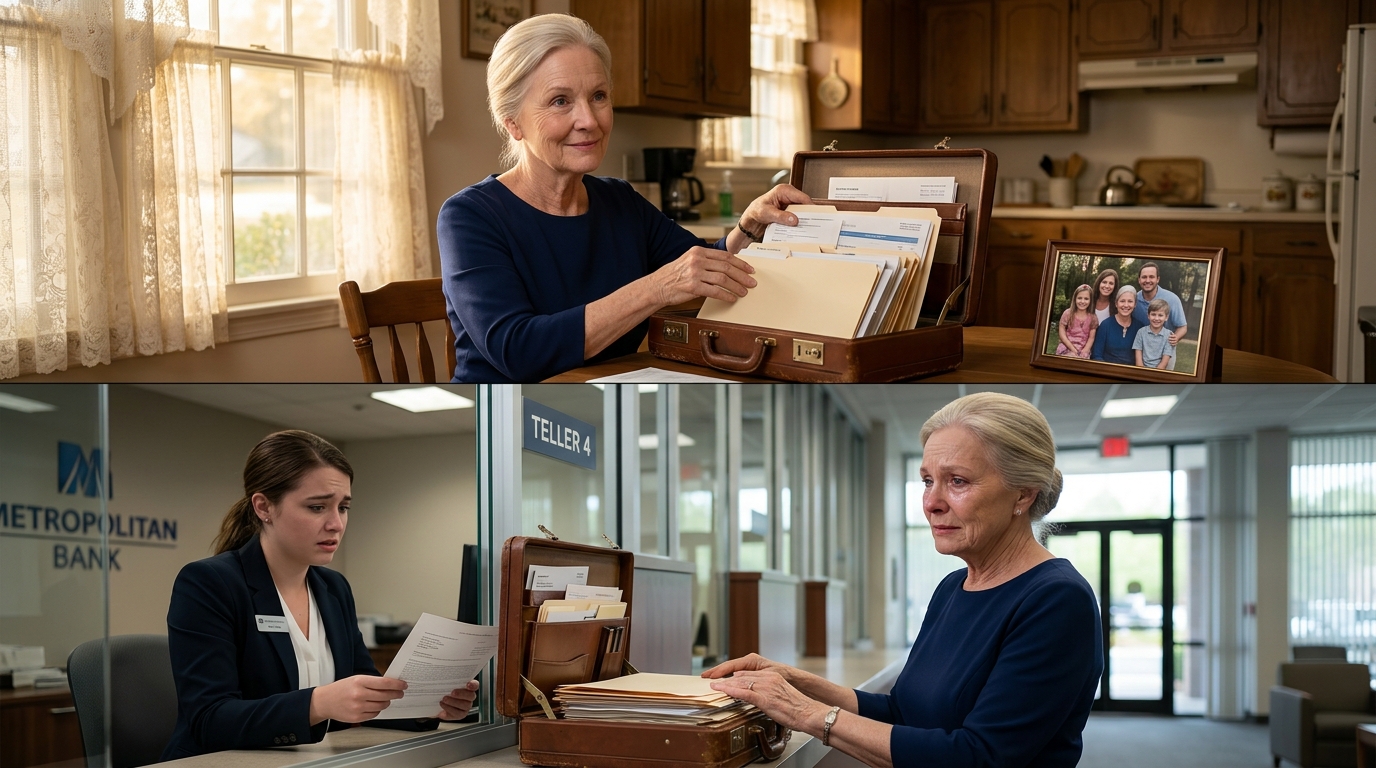
That evening, Edna carried Harold’s old leather briefcase downstairs and placed it on the dining room table.
She hadn’t opened it in months.
The leather creaked beneath her fingers as she lifted the lid.
Inside were neatly organized investment statements.
Property documents.
Bank records.
Account information.
And one letter written in Harold’s familiar handwriting.
Edna unfolded it carefully.
Harold had always insisted that they live simply.
Used cars.
Coupons.
A modest home.
No luxury vacations.
No flashy jewelry.
Nothing that would ever suggest extraordinary wealth.
Lucille had grown up believing her parents were ordinary working people who had carefully saved enough to survive.
She had never known about Harold’s investments.
She had never known about his real estate holdings.
She had never known that decades earlier, Harold had helped build a technology company that eventually became extraordinarily valuable.
And she certainly had never known what he had left behind.
Edna had never told her.
Not because she wanted to deceive her daughter.
Harold had simply believed that money had a dangerous way of changing people.
“Character is easiest to see,” he once told Edna, “when money isn’t in the room.”
Sitting alone at that dining table, Edna finally understood exactly what he had meant.
She picked up her phone.
Then she called Robert Jennings, the family’s longtime financial adviser.
He answered even though it was late.
“Mrs. Morrison? Is everything all right?”
“I need to make some arrangements tomorrow,” Edna said.
Robert immediately heard something unusual in her voice.
“What kind of arrangements?”
“Large transfers.”
A pause followed.
“How large?”
Edna looked toward the dark hallway where Lucille had disappeared earlier that evening.
“All of it.”
Robert went silent.
When he finally spoke, his voice was cautious.
“Are you sure?”
Edna looked down at Harold’s photograph.
“I’ve never been more sure.”
The following morning, Edna woke early.
She put on her best navy dress.
She carefully styled her hair.
Then she picked up Harold’s leather briefcase and left the house.
A short time later, she walked through the glass doors of First National Bank.
An American flag stood beside the lobby entrance.
Phones rang behind polished counters.
Customers waited in line beneath bright ceiling lights.
Employees moved efficiently between offices.
And behind one of the teller stations stood Lucille.
Her hair was pulled into the same severe bun.
Her uniform was perfectly pressed.
A professional smile appeared effortlessly on her face as she helped an elderly customer.
She hadn’t noticed her mother enter.
Robert Jennings was already waiting near the private banking offices.
He carried a thick stack of documents.
When Edna approached, he studied her expression carefully.
“One last time,” he said quietly. “Are you certain you want to do this?”
Edna glanced across the lobby at Lucille.
“Yes.”
For nearly two hours, Edna sat inside the private banking office signing documents.
Page after page.
Account after account.
Transfer after transfer.
When everything was finished, Robert placed the final paperwork in front of her.
Edna signed her name.
Then she closed Harold’s briefcase.
She walked back into the main lobby.
This time, she headed directly toward Lucille’s station.
Lucille looked up.
Her professional smile disappeared instantly.
“Mom?”
Her eyes narrowed.
“What are you doing here? I already told you I can’t give you money.”
Edna calmly placed the leather briefcase on the counter.
“I’m not here to ask you for money.”
Lucille rolled her eyes.
“Then what are you doing here?”
Without answering, Edna opened the briefcase.
She removed a transaction slip.
Then she slid it across the polished counter.
“I’m here to make a transaction.”
Lucille barely glanced at it.
Then she stopped.
Her eyes snapped back to the paper.
She read the number once.
Then twice.
Her lips parted.
The color slowly drained from her face.
$260,000,000.
Lucille’s fingers tightened around the transaction slip.
A customer standing at the next window noticed the sudden silence.
One of Lucille’s coworkers stopped talking.
Lucille stared at her mother as though she were seeing a stranger.
“Mom…”
Edna said nothing.
Lucille looked down at the amount again.
→
Her voice trembled as she finally managed to speak, the casual cruelty from the previous morning completely vanishing.
“”Is this… is this real?”” Lucille stammered, her eyes darting frantically between the slip and her mother’s composed face. “”Two hundred and sixty… million? Mom, whose account is this? What is going on?””
Edna did not blink. She stood perfectly straight, the quiet dignity of decades of hard work radiating from her small frame.
“”It is your father’s legacy,”” Edna said evenly. “”And mine. We built it together, long before you cared about granite counters and perfectly pressed uniforms.””
Lucille’s hands began to shake violently. The reality of the numbers on the page was crashing into her, dismantling every assumption she had ever made about her quiet, unassuming mother. The woman she had called a leech, the woman she had begrudged a hundred-dollar loan, was standing across from her with more wealth than the entire branch managed in a decade.
Suddenly, Lucille’s posture shifted. The cold, dismissive banker melted away, replaced by a desperate, fawning imitation of a loving daughter.
“”Mom, why didn’t you tell me?”” Lucille forced a breathless, high-pitched laugh, reaching across the polished counter to touch Edna’s hand. “”We could have… we could have done so much together! Oh my god, you don’t have to stay in that tiny room anymore. We can remodel the master suite for you. We can go on vacation! I am so, so sorry about yesterday. I was just stressed from work, you know how it gets—””
Edna slowly pulled her hand back. The movement was slight, but it carried the weight of absolute finality.
“”I know exactly how it gets,”” Edna replied softly. “”Your father always said that character is easiest to see when money isn’t in the room. Yesterday, there was no money in that kitchen. And I saw everything I ever needed to see.””
Lucille’s face flushed a deep, mottled red. “”Mom, please. You know I didn’t mean it. You’re my mother!””
“”And you are my daughter,”” Edna said. “”Which is why I am ensuring you never have to worry about the burden of taking care of me again.””
Robert Jennings stepped up beside Edna, his presence authoritative and calm. He slid a secondary, much thicker document across the counter.
“”Mrs. Morrison is closing all accounts currently held at this institution,”” Robert informed the stunned teller. “”The entire portfolio is being transferred to a blind trust managed by my firm, effective immediately. The funds will be distributed to various charitable foundations, educational grants for underprivileged children, and Mrs. Morrison’s personal estate.””
Lucille gasped, stumbling back half a step. “”You’re taking it away? All of it? From your own daughter?””
“”I am taking my money, Lucille. The money you told me to go get a job for,”” Edna said, her voice never raising, never breaking. “”I am moving out this afternoon. You will find the house keys on the kitchen counter, right where you left your coffee mug yesterday.””
“”You can’t do this!”” Lucille hissed, her professional veneer completely shattering as coworkers and customers openly stopped to stare. “”I’m your only child! You owe me!””
Edna looked at the frantic woman behind the glass. She felt a brief, dull ache in her chest—grief for the little girl she had once raised—but it was quickly washed away by the immense, liberating clarity of the present.
“”I owed you a good childhood, Lucille. I owed you an education. I owed you love. Your father and I gave you all of those things, paid for with our sweat and our sacrifices.”” Edna picked up her leather briefcase, securing the brass clasp with a sharp snap. “”But I do not owe you my dignity.””
Without another word, Edna Morrison turned around. She walked across the polished marble floor of the bank, her head held high, leaving her daughter standing frozen behind the counter, staring at a piece of paper that represented everything her cruelty had just cost her.
When Edna pushed through the heavy glass doors and stepped out into the bright morning sun, she didn’t look back. She hailed a taxi, gave the driver the address to the finest luxury hotel downtown, and for the first time in her sixty-two years, she didn’t even check to see how much the fare would be.”