
My Brother Called My Daughter a “Mistake,” and the Silence That Followed Changed Everything
My name is Jessica Whitaker, and for most of my adult life, I believed there were certain things a family could say to you that you were expected to survive quietly.
A cruel joke at Thanksgiving.
A smiling insult wrapped in “I’m only telling you because I love you.”
A look across a table that reminded you, without words, that your place in the family had been decided long before you learned how to defend yourself.
I had been called dramatic, sensitive, stubborn, ungrateful, and difficult. I had been reduced to a cautionary tale more times than I could count. But I never thought they would point that same old cruelty at my six-year-old daughter.
Her name was Harper.
She had missing baby teeth, a drawer full of mismatched socks, and a serious belief that pancakes tasted better if they were shaped like animals. She still said “hospital” instead of hospital and thought the moon followed our car home at night. She was the kind of child who waved at grocery cashiers, thanked automatic doors, and apologized to furniture if she bumped into it.
So when my brother took her photograph and turned her into a family punchline online, something in me went very still.
It was a Saturday in Santa Fe, New Mexico, warm enough for short sleeves but cool enough that the wind still carried a dry desert edge. I was thirty-four years old and working as an education coordinator at the Museum of Desert Discovery, a small but well-loved place where school buses lined up on weekday mornings and children left with paper lizards, clay coyotes, and sand in their sneakers.
That morning, I had been running a children’s workshop at a community festival. We had tables covered in construction paper, glue sticks, feathers, seed pods, and plastic bins full of fossil replicas. I still had my name badge pinned to my blouse and a streak of purple marker on my wrist when my phone began buzzing in my tote bag.
At first, I thought it was Ethan, my husband, asking whether Harper wanted lunch before we drove home.
Then I saw the photo.
Harper was sitting on a painted wooden coyote outside one of the festival booths. Her cheeks were pink from laughing. One hand was lifted in a blurry little wave, the way children wave when they are too happy to pose properly. She had a sticker on her shirt and dust on one knee.
Under the photo, my brother Caleb had written:
“Some mistakes grow up and make more mistakes.”
For a few seconds, I did not understand what I was seeing.
Not because the words were complicated.
Because my mind refused to place those words beside my child’s face.
Then I saw my mother’s reaction.
Three laughing emojis.
Not one, tapped carelessly.
Three.
Below that, my cousin Ashley had written, “Savage.”
An old church friend of my mother’s commented, “Family humor is undefeated.”
Someone from Caleb’s real estate circle added, “Some people never learn consequences.”
Another woman wrote, “This is what happens when girls grow up too fast.”
My throat closed so hard I had to sit down on the curb beside the booth. Around me, children were laughing, parents were buying lemonade, and a volunteer from the library was handing out bookmarks shaped like roadrunners. The world kept moving in its ordinary Saturday way while my daughter’s face sat on the internet under a sentence designed to humiliate both of us.
I must have made some sound, because Ethan turned from the food truck line and crossed the gravel toward me.
“What happened?” he asked.
I handed him the phone.
His expression changed before he said a word.
Ethan Brooks was not Harper’s biological father. My family never let him forget that, though Harper had never known another dad. He had met me when she was two, married me when she was four, and loved her in all the unglamorous ways that count. He packed her lunches with the crusts cut off because she said crust made sandwiches “too bossy.” He sat through kindergarten music programs with tears in his eyes. He knew which stuffed rabbit needed to be tucked under her left arm before she could fall asleep.
He read the caption once.
Then he looked at the comments.
He did not tell me to calm down. He did not say Caleb probably meant something else. He did not suggest that my mother must have misunderstood.
He simply took the phone from my hand and said, very quietly, “Screenshot everything.”
That was the moment I knew this would not end with an awkward apology over Sunday dinner.
We drove home without the radio on.
Harper sat in the back seat, chattering about the wooden coyote, the pottery booth, and the sticker she had received from a woman who said she had “excellent creative instincts.” Every happy word out of her mouth made the caption feel uglier.
At a red light, Ethan reached across the console and took my hand.
I stared out the windshield at the road shimmering in the afternoon heat.
“I don’t want her to know,” I whispered.
“She already might,” he said gently. “Kids hear more than we think.”
When we got home, I gave Harper apple slices, crayons, and a pile of printer paper in the den. Then I locked myself in the laundry room with Ethan because it was the only room far enough from her ears.
The laundry room smelled like detergent and dryer sheets. A basket of Harper’s clean pajamas sat on top of the machine, little cotton sleeves hanging over the side. It felt obscene somehow, standing beside her tiny clothes while adults online laughed at her existence.
Ethan opened his laptop on top of the dryer and made a folder.
Screenshots.
Names.
Timestamps.
Reactions.
Shares.
He moved with a calm precision that kept me from falling apart.
“Jess,” he said, “your brother didn’t just insult you. He used Harper’s image without permission and attached a cruel caption to it. Your mother helped it spread. People are making comments about both of you.”
I wanted to defend my mother out of habit.
I wanted to say she probably had not read it carefully. That maybe she thought Caleb was joking about me, not Harper. That maybe the laughing emojis were just her usual way of smoothing over anything Caleb did.
But I was tired.
Tired in a way that went back years.
My mother, Diane Whitaker, had always cared deeply about appearances. Not kindness. Not truth. Appearances.
She was the kind of woman who could make a church potluck table look like a magazine spread. She chaired charity luncheons, mailed handwritten thank-you notes, and spoke in a soft, polished voice that made cruelty sound like concern. She knew how to say, “We’re just worried about you,” in a way that meant, “You embarrassed us.”
My older brother Caleb was her pride.
He was handsome in a clean-cut, open-house brochure sort of way. He staged luxury homes for realtors, posted videos about taste and legacy, and spoke online about family values with the confidence of a man who had never paid his own emergency dental bill without help from our mother.
He had charm.
People mistook that for character.
I was the daughter who had gotten pregnant at twenty-one.
I was the daughter who finished college at night, worked part-time jobs, cried in parking lots, and learned how to stretch a grocery budget until it squeaked. My family called me “strong” when they wanted to brag at church. They called me a “mistake” when they wanted to remind me where I belonged.
That evening, while I was pretending to make pasta, Harper wandered into the kitchen holding the picture she had drawn at the festival.
It was a purple coyote with wings.
“Mommy?” she asked.
I turned down the stove.
“Yes, baby?”
She held the drawing against her chest.
“Why did Grandma put laughing faces on my picture?”
The wooden spoon stopped in my hand.
Ethan, who had been setting plates on the table, looked up slowly.
For one second, I hated everyone who had made me choose words carefully in my own kitchen.
I knelt in front of her.
“Sometimes grown-ups use the internet badly,” I said.
Harper frowned.
“Was Uncle Caleb making fun of me?”
I felt my heart crack open in a quiet, permanent way.
“You did nothing wrong,” I said. “Nothing. You were happy in a picture, and grown-ups made a bad choice with it.”
She looked down at her socks.
“Is he mad because of me?”
“No,” Ethan said before I could answer.
His voice was steady, but I could see the muscle tightening in his jaw.
He crouched beside me.
“Adults are responsible for their own choices,” he told her. “You are not responsible for anyone being unkind.”
Harper nodded, but her eyes had gone serious.
Children know when adults are lying around the edges.
Later, after she fell asleep, I opened Caleb’s post again.
It had been shared fourteen times.
My mother had added a comment.
“People are too sensitive these days.”
That sentence changed something in me.
Grief became strategy.
By midnight, Ethan had saved every comment.
By one in the morning, I had emailed an attorney named Marin Cole, whose business card I had kept after a museum liability seminar the year before.
By sunrise, the post was still up.
On Monday morning, I walked into the museum wearing concealer under my eyes and a smile I did not have the strength to mean.
The Museum of Desert Discovery was not glamorous, but it was mine in the way a place becomes yours after you have poured years of care into it. I designed programs for children who needed the world to feel less overwhelming. Fossil puzzles. Sensory-friendly exhibit hours. Bilingual scavenger hunts. Craft tables where shy kids could touch clay, feathers, and smooth desert stones and leave believing their questions mattered.
My job was to make children feel safe enough to be curious.
That was why Caleb’s post did not remain in the category of family drama.
By ten that morning, two parents from a donor committee had seen it.
One sent a careful email to my work address saying she was “concerned about public conflict involving a child connected to museum staff.”
Another asked whether the museum’s social media policy covered online disputes.
I sat in my office surrounded by foam cactus cutouts and paper lizards, reading those messages while preschoolers sang in the next room.
My brother had taken my daughter’s face, his old resentment, and my mother’s approval, then turned all of it into something that could touch my professional reputation.
Marin called me during lunch.
Her voice was calm in the way good lawyers are calm, not because they are unmoved, but because they already know where the exits are.
“Do not message him emotionally,” she said. “Do not argue in the comments. Preserve everything. Ask once in writing for removal. If he refuses or escalates, we send formal notice.”
The words formal notice made my stomach drop.
Some part of me still wanted my mother to call and say Caleb had gone too far.
Instead, she called at 12:37 p.m. and opened with, “Are you really making a big thing out of Caleb’s joke?”
I stepped into the storage hallway between bins of puppet supplies and pressed the phone to my ear.
“He called my daughter a mistake.”
“He didn’t mean Harper.”
“He used her picture.”
“He meant the situation.”
“The situation has a name, Mom. She is six.”
My mother sighed.
It was the sigh she used when she wanted me to feel childish.
“Jessica, you always take everything as an attack. Caleb is under pressure right now. His business has been slow. He needs engagement. You know how social media works.”
For a moment, I could not speak.
My daughter had been turned into engagement.
And my mother had just admitted it without shame.
“Take it down,” I said. “Tell him to take it down and apologize.”
Her voice hardened.
“Do not threaten your brother over a Facebook caption.”
“I’m not threatening him. I’m warning you both that this crossed a line.”
“Your tone is exactly why these things escalate.”
“No, Mom. These things escalate because people do cruel things and expect silence from the people they hurt.”
She went quiet.
Then she said, “You need to remember that family problems should stay in the family.”
I looked down the hallway at a plastic bin labeled KINDERGARTEN TOUCH TABLE.
“They stopped being private when Caleb posted my child online.”
I hung up before she could turn that sentence into another lecture.
That afternoon, I sent Caleb one text written exactly as Marin advised.
Remove the post using Harper’s image and caption by 6 p.m. today. Do not repost, share, or reference her again. Please confirm when removed.
Twenty minutes later, he responded with a laughing GIF.
Then he posted a story showing a screenshot of my text. He had covered my name, but not enough.
His caption read:
“When people weaponize motherhood because they can’t take a joke.”
My phone began buzzing again.
Not just relatives now.
Strangers.
Men with sunglasses profile pictures.
Women from local Facebook groups.
Someone commented on the museum’s public page, “Maybe your staff should learn humor before teaching kids.”
I locked my office door and sat on the floor behind my desk.
For five minutes, I let myself shake.
Then I forwarded everything to Marin.
At home that evening, Ethan cooked dinner because I kept forgetting what I was holding. I opened the refrigerator and stood there staring at a carton of eggs like I had never seen food before.
Harper was quieter than usual.
She pushed peas around her plate.
Finally, she asked, “Is Uncle Caleb going to come over?”
“No,” I said.
“Is Grandma?”
“Not tonight.”
She nodded, then whispered, “Did I make everybody fight?”
Ethan set his fork down so slowly it made no sound.
I moved my chair closer to hers.
“No, baby. You did not make anybody fight.”
“But it was my picture.”
“It was your picture,” I said, “and grown-ups made choices about it that were not okay. That is not your fault.”
She looked from me to Ethan.
“Are you mad?”
“Yes,” I said softly. “But not at you.”
Her eyes filled.
That was the moment I stopped wondering whether legal action would make me a bad daughter or a bad sister.
The only question left was whether doing nothing would make me a bad mother.
Caleb agreed to meet me on Wednesday morning at Juniper and Stone, a cafe with white walls, blue mugs, and customers who lowered their voices the second they sensed drama enter a room.
I chose a public place because I did not trust him not to twist the conversation. I wore my museum blazer because I needed armor, even if it was just linen and a name tag I forgot to remove.
Caleb arrived twelve minutes late.
He had sunglasses pushed into his hair, a navy jacket, and the smell of expensive cologne that always preceded him by about three feet.
He kissed the air near my cheek as if we were at a fundraiser.
“Jess,” he said, sliding into the chair across from me. “You look intense.”
I placed my phone face up on the table.
“This conversation is being recorded.”
His smirk faltered.
“Wow. We’re doing court TV now?”
“We’re doing clarity.”
He leaned back, amused again.
“Fine. Say your piece.”
I had rehearsed angry speeches in the shower, in the car, while packing Harper’s lunch. But when I looked at him, all I could see was Harper staring at her cereal, asking whether someone was mad because of her.
So I kept my voice low.
“You posted my child’s photo without permission. You called her a mistake. You let people insult her and me. Then you reposted my private message for attention. Remove everything and apologize publicly.”
Caleb rolled his eyes.
“I didn’t call Harper a mistake. I called your life choices a mistake. There’s a difference.”
The words landed with such clean cruelty that I almost admired how little he tried to hide it.
“You used her picture because it made the joke obvious.”
“She’s six,” he said. “And you were twenty-one when you got pregnant, Jessica. Are we all supposed to pretend that didn’t derail the family?”
A woman at the next table stopped stirring her coffee.
I felt heat climb my neck, but I refused to look away.
“You mean it derailed Mom’s fantasy of what I was supposed to look like.”
Caleb’s face tightened.
“No. I mean you got praised for surviving a mess you created while I got blamed for not being perfect enough. Every family dinner became about poor Jessica. Brave Jessica. Look how strong Jessica is. You built a personality out of consequences.”
There it was.
Not humor.
Not a bad joke.
A decade of resentment wearing a caption.
“And your solution,” I asked, “was to humiliate a child?”
His mouth twitched.
“Your husband is making you dramatic. He’s not even her real father, but he acts like he owns the family now.”
My chair scraped against the floor before I realized I had moved.
“Do not talk about Ethan.”
Caleb smiled because he thought he had found the nerve.
“See, that’s the problem. You replaced us, and now you want to punish us for not clapping.”
I stood, but I did not leave yet.
I wanted him to hear every word.
“No, Caleb. I stopped begging people to love my daughter quietly. That is not replacement. That is parenting.”
He lifted both hands.
“Send your little letter, then. I know people. You really want museum donors and charity boards hearing how unstable you are?”
That was the part I had not expected.
He was not just refusing to apologize.
He was threatening my job.
I picked up my phone.
My hands were steady now.
“Thank you for confirming intent.”
His smile disappeared.
“What does that mean?”
“It means you just helped my attorney.”
I walked out before he could answer.
In the parking lot, I sat in my car and replayed the recording once.
His voice filled the small space.
“I didn’t call Harper a mistake. I called your life choices a mistake.”
“You really want museum donors and charity boards hearing how unstable you are?”
I sent it to Marin.
Then I sent one message to Ethan.
He admitted enough.
Ethan replied almost immediately.
Come home. We’ll handle it.
For the first time all week, I believed him.
The legal letters went out the next Monday.
They were not soft.
Marin drafted separate notices to Caleb and my mother.
Caleb’s letter demanded immediate removal of all posts and stories containing Harper’s image or references to her as a mistake. It demanded a written apology, preservation of all related communications, and a halt to any contact with my employer, museum donors, community partners, or professional network.
My mother’s letter was different.
It named her participation in amplifying the post, her comments dismissing the harm, and her position in local charity circles where her words carried influence.
Diane Whitaker had spent years building an identity around being the elegant woman who chaired luncheons, arranged silent auctions, and gave little speeches about protecting children in our community.
Now she was receiving a formal letter asking why she had publicly laughed at the degradation of her own granddaughter.
At 9:14 a.m., Caleb called.
I did not answer.
At 9:16, my mother called.
I did not answer.
At 9:18, Caleb texted, You’ve lost your mind.
At 9:21, my mother texted, Call me before you destroy this family.
At 9:30, Ethan put my phone in a kitchen drawer and said, “They can talk to Marin.”
But they did not want Marin.
They wanted the old Jessica.
The one who could be cornered, guilted, pressured, and reminded that family loyalty meant absorbing injury quietly.
By noon, Caleb had called nineteen times.
My mother had called eleven.
A cousin left a voicemail saying I was taking food out of Caleb’s mouth.
Another relative messaged that legal action was “low-class behavior,” which told me exactly how they had always talked about my life when I was not in the room.
Then the second wave hit.
Caleb’s staging business had a partnership pending with a boutique real estate firm that worked with family relocation clients. Someone at that firm saw the screenshots because Caleb’s own followers had spread them.
They asked him to explain.
He panicked and deleted the original post.
But deletion came too late.
Screenshots had already traveled farther than his charm could reach.
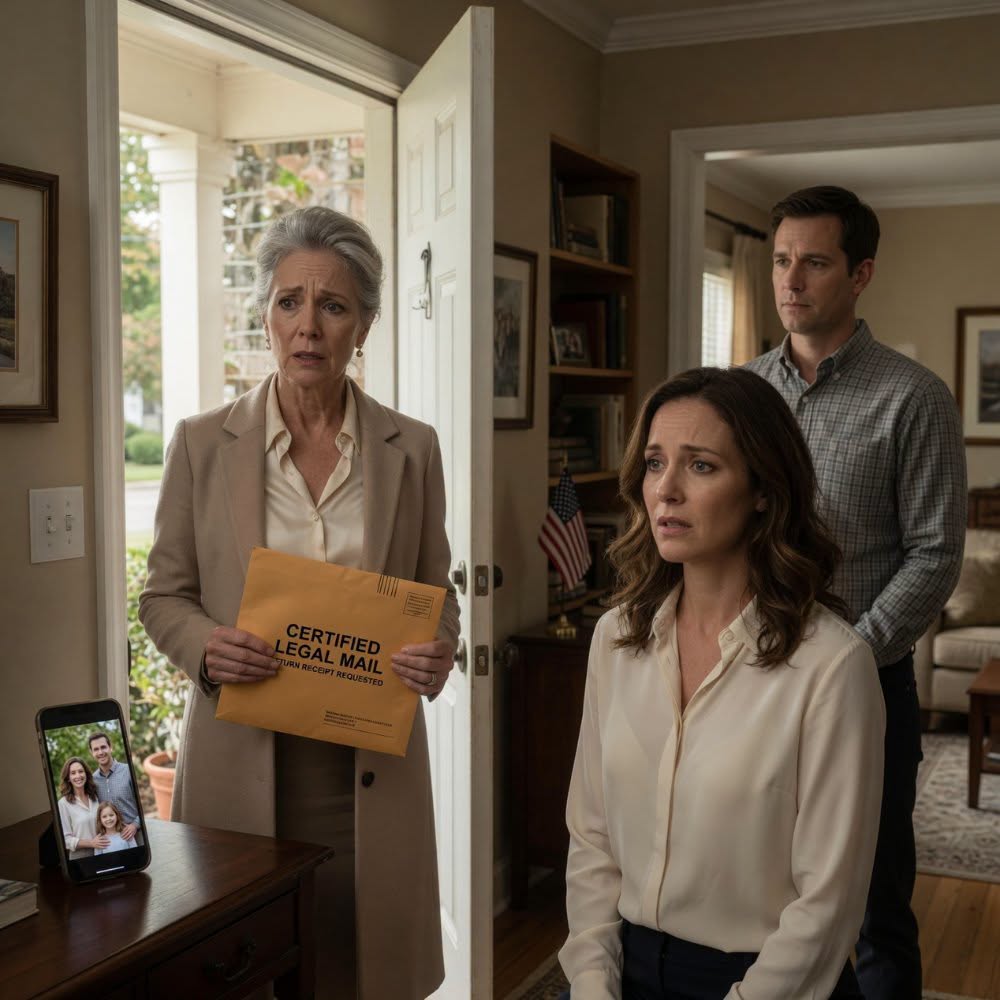
That evening, my mother appeared at our front door holding the certified envelope like it was something dead.
Ethan opened the door but did not invite her in immediately.
“Is Harper awake?” she asked.
“No,” he said.
“Good,” she snapped. “Because apparently everything I say is evidence now.”
I stepped beside him.
“If you came to apologize, come in. If you came to blame me, leave.”
Her eyes flashed.
“Apologize? Caleb may lose a contract because of you.”
“Caleb may lose a contract because he used a child as a punchline and threatened my job.”
She tried to step into the entryway, but Ethan did not move aside.
He blocked the hallway with his body, calm and immovable.
“Diane,” he said, “you need to lower your voice.”
She looked at him like furniture had spoken.
“This is family.”
“So is Harper,” he said.
That shut her up for half a second.
I wish I could say it softened her.
It did not.
She turned to me with tears already prepared.
“Do you know what your brother is going through? He borrowed money to keep his business afloat. He has clients pulling back. He’s embarrassed.”
“He should be embarrassed.”
“I gave him money from my retirement account,” she blurted. “He cannot afford legal trouble.”
That was the first crack in the wall.
Ethan glanced at me.
I stared at my mother.
“How much money?”
She looked away.
“That is not your concern.”
It became my concern two days later.
Marin forwarded a packet from Caleb’s former assistant, a woman named Belle, who had seen the posts and decided she was tired of protecting him.
Belle claimed Caleb had been using my mother’s charity contacts to promote his staging business. He offered discounted design consultations at fundraising events, blurred personal connections with professional favors, and used the language of community service to find paying clients.
Worse, according to Belle, Caleb had drafted posts from my mother’s account before. That made it unclear whether Diane had merely reacted with laughing emojis or allowed him access to amplify the humiliation.
Suddenly, this was no longer only about one cruel caption.
It was about a family machine that had used reputation as currency.
And my daughter had become collateral.
Marin told me to breathe before she explained the strategy.
“We do not need to sue first,” she said. “We need leverage, documentation, and a controlled demand. If they want this quiet, they will repair the harm publicly and privately.”
“What does repair even look like?” I asked.
Because money could not unmake Harper’s question.
An apology could not erase the comments.
Marin paused.
“Repair is not magic,” she said. “It is consequence made visible.”
That sentence stayed with me all night.
The confrontation happened on a Friday evening in my living room, under the paper stars Harper and I had made for a museum craft night.
Marin attended by video call on Ethan’s laptop. My mother and Caleb did not know that until they arrived.
They both dressed like they were attending a meeting where appearances might still save them.
Caleb wore a navy jacket.
My mother wore pearls.
I wore jeans and no makeup because I was done costuming myself for people who had never mistaken my softness for anything but weakness.
“This is ridiculous,” Caleb said the second he saw the laptop. “You brought a lawyer into your house against your own brother?”
Marin’s voice came through the speaker.
“Good evening, Mr. Whitaker. This meeting is voluntary. You are free to leave.”
He did not.
That was how I knew fear had finally entered the room.
I placed a folder on the coffee table.
Inside were screenshots of the original post, the comments, the story mocking my text, the cafe recording transcript, donor messages, museum page comments, call logs, and Belle’s statement.
My mother stared at the folder but did not touch it.
“Jessica,” she said in the voice she used at charity luncheons, “surely we can resolve this without humiliating anyone further.”
I almost laughed.
“Further?”
Her eyes moved to mine.
“Harper was humiliated first,” I said. “I am just refusing to keep it private for your comfort.”
Caleb leaned forward.
“She’s six. She doesn’t even understand half of this.”
“She understood enough to ask if she was a mistake.”
His expression twitched.
My mother closed her eyes.
For the first time, I saw something like shame cross her face.
But Caleb filled the silence before it could grow.
“You coached her to say that.”
Ethan stepped forward so fast the air changed.
He did not yell.
That made it worse.
“Careful,” he said.
Caleb looked at him, then at me.
“What? We’re all pretending Jessica doesn’t dramatize everything?”
I opened the folder and took out one printed page.
“This is from the cafe,” I said. “You said you didn’t call Harper a mistake. You called my life choices a mistake. You said it made the joke obvious. You also said, ‘You really want museum donors and charity boards hearing how unstable you are?’”
My mother looked at Caleb.
“You said that?”
He swallowed.
“She was recording me.”
Marin spoke calmly.
“And you were speaking voluntarily in a public cafe after being informed.”
Caleb’s confidence cracked.
Not shattered yet.
But cracked enough for truth to leak out.
“I was angry,” he said. “Do you have any idea what it’s like being compared to her?”
He pointed at me.
“She gets pregnant, struggles, and suddenly everyone worships her for being strong. I try to build something and Mom treats me like a disappointment unless I perform success every second.”
My mother flinched.
“Caleb.”
“No, don’t Caleb me,” he snapped. “You gave me money and then held it over me. You made me bring clients to your luncheons. You wanted me to look successful because it made you look successful.”
The room went silent.
I had spent the week imagining Caleb as a cartoon villain.
He was cruel, yes.
But he was also my mother’s creation in ways none of us wanted to admit.
That did not excuse him.
It explained the shape of the damage.
My mother sank into the armchair.
“I was trying to help you.”
“You were trying to curate us,” I said.
My own voice surprised me.
“You curated Caleb into the golden son, me into the cautionary tale, and Harper into proof that my mistake continued. You laughed because the caption matched a story you have been telling yourself for years.”
My mother’s mouth opened.
No defense came out.
I continued because stopping would have been easier, and I was done choosing easy.
“Here are the terms. Caleb posts a public apology drafted with Marin’s approval. He states clearly that Harper was targeted unfairly, that the caption was cruel, that I did not consent to her image being used, and that no child should be spoken about that way. He removes all posts and agrees not to mention Harper online again. He sends written notices to the real estate firm and any contacted donors stating that his comments about me were retaliatory and false.”
Caleb’s face had gone pale.
I kept going.
“He contributes to the museum’s sensory-friendly children’s fund. Not as hush money. Because he harmed a child in a public space.”
My mother’s hand tightened around her purse strap.
“And Mom, you step down from the Children’s Futures Luncheon committee this season.”
Her head snapped up.
“Absolutely not.”
“Then we release the documentation to the committee chair and proceed.”
Caleb looked sick.
“You would ruin us.”
I looked at him for a long moment.
“No. I am giving you the chance to stop ruining yourselves in public.”
My mother started crying then.
Not the polished tears she could arrange into dignity.
The ugly kind.
“She’s my granddaughter,” she whispered.
Ethan’s voice was quiet.
“Then act like it.”
Harper’s bedroom door creaked.
We all turned.
She stood there in yellow pajamas holding her stuffed rabbit.
My heart dropped.
I did not know how long she had been awake.
“Mommy,” she asked, “is Grandma sad because of me?”
I crossed the room and knelt before her.
“No, baby. Grandma is sad because grown-ups made bad choices and now they have to fix them.”
Diane covered her mouth with both hands.
Caleb looked at the floor.
Maybe that was the first real consequence.
Not a letter.
Not money.
Not reputation.
A child hearing the truth stated plainly enough that nobody could twist it.
The apology went up three days later at seven p.m., which Marin chose because Caleb’s audience was most active then.
I know because he complained about the timing in three separate emails.
His post was plain black text on a white background.
No flattering angle.
No music.
No smug little caption.
I posted a photo of my six-year-old niece without her mother’s permission and wrote a cruel caption that suggested she and her mother were mistakes. It was not humor. It was harmful. I apologize to Harper, Jessica, and Ethan. I also apologize for allowing and encouraging comments that attacked them. No child should be used as a punchline, and I take responsibility for the damage I caused.
He had to pin it for thirty days.
He had to turn off promotional content for the week because Marin did not want him profiting from the apology.
He had to send letters to the real estate firm and the museum donors he had threatened to influence.
He had to make a contribution to the museum’s sensory-friendly access fund large enough to hurt, but not large enough for him to brag about like a philanthropist.
My mother’s consequence was quieter but sharper.
She stepped down from the Children’s Futures Luncheon for “personal reasons,” though everyone in that circle knew enough to understand.
The committee chair, a woman named Patricia, called me personally.
She did not ask for gossip.
She said, “I am sorry your daughter was treated that way. We would be honored if your museum team advised next year’s children’s programming.”
That was the kind of reversal I had not expected.
Caleb lost the boutique real estate partnership anyway.
Not because I called them.
I did not have to.
His own apology, his own followers, and his own pattern did what my silence had protected him from for years.
Belle later told Marin that two other clients had come forward complaining that Caleb mocked homeowners online after consultations.
His business did not collapse overnight.
But the image did.
For a man who sold image, that was devastating.
My mother tried to visit Harper the next week with a pink gift bag and a face full of regret.
I met her outside first.
“No gifts before accountability,” I said.
She looked wounded.
Then she nodded.
When she came in, she sat at the kitchen table across from Harper and said the hardest sentence I had ever heard from her mouth.
“I laughed at something that hurt you. I was wrong. You are not a mistake. You are my granddaughter, and I should have protected you.”
Harper listened carefully.
Then she asked, “Are you going to do it again?”
My mother cried.
“No.”
Harper considered this with the seriousness only children can bring to simple morality.
“Okay,” she said. “But Mommy says sorry means you change.”
I had to turn away because my eyes filled faster than I could stop them.
That became the rule in our house after everything.
Sorry means you change.
Caleb did not get access to Harper.
Not then.
Maybe not ever.
People kept asking if I was sad to lose my brother, but the truth was more complicated.
I was sad that I had spent so many years trying to earn kindness from someone who thought cruelty was honesty.
I was sad that my mother needed legal paper to see a child’s pain.
I was sad that family systems can train you to call disrespect humor, favoritism tradition, and silence peace.
But I was not sad that I defended my daughter.
Not for one second.
A few weeks later, Harper and I stood inside the museum’s new sensory room, watching children run their fingers over textured desert murals funded partly by Caleb’s required contribution.
There was a quiet poetry in that.
The insult that had tried to shrink my daughter had helped create a space where other children could feel safe.
Ethan stood beside me, his hand warm against my back.
“You okay?” he asked.
I watched Harper show another little girl how to press the button that made a recording of owl wings play softly overhead.
She was laughing again.
But this time, nobody owned the image except her.
“I’m getting there,” I said.
That night, after Harper fell asleep, I opened the folder one last time.
Screenshots.
Letters.
Call logs.
Apology.
Proof.
For years, I thought evidence was something you collected because you wanted revenge.
Now I understand that sometimes evidence is what you collect because people keep asking you to doubt your own pain.
Family is not a license to harm you.
Blood does not turn cruelty into comedy.
A grandmother’s laugh can wound.
A brother’s caption can scar.
And a mother’s silence can teach a child the wrong lesson forever.
But a boundary can teach a better one.
Protection is not drama.
Accountability is not betrayal.
And when a child asks whether she is a mistake, the answer cannot be whispered in private while the insult stays public.
It has to be louder than the people who laughed.
I used to believe keeping the family together was the highest form of love.
Now I know that sometimes love means being brave enough to break the pattern before it reaches your child.
What came after did not feel like victory. It felt like waking up in a house after a storm and realizing the roof was still there, the walls were still standing, but every window had fingerprints on it from people who had tried to look inside while pretending they had only been passing by.
For a while, I thought the apology would be the ending. I thought Caleb’s pinned post, my mother’s resignation from the luncheon committee, and the new boundaries around Harper would close the door. I imagined the whole thing settling into the kind of ugly family memory people do not mention at holidays, not because it healed, but because everyone learns where the sharp edges are. I was wrong. Public humiliation has a strange afterlife. It does not vanish when the post comes down. It moves into glances at the grocery store, pauses in school pickup lines, careful smiles from women who know too much, and the slightly lowered voices of people who have chosen politeness over honesty.
The first weeks after Caleb’s apology were the strangest. In the museum, parents became overly kind to me. They used gentle voices, asked whether I needed help carrying boxes, and looked at Harper with soft pity when she visited after school. Pity made me angry in a way cruelty never had. Cruelty was open enough to fight. Pity wrapped itself around my daughter like a label, as if one cruel caption had turned her from a child into a community lesson. I began arranging my schedule so she did not have to sit in my office after school as often. Ethan picked her up when he could, and when he could not, I asked a trusted neighbor, Mrs. Ruiz, who lived two houses down and had a backyard full of wind chimes.
Harper did not speak about the post every day, but children carry hurt in scattered ways. She began asking before I took her picture. She asked where the picture would go, who would see it, whether Grandma would see it, whether Uncle Caleb could see it if I sent it to anyone. She stopped waving at people who held phones. At the grocery store, when an older woman smiled at her in the cereal aisle and lifted a phone to check a list, Harper moved behind my leg so quickly I felt her little hands grip the back of my jeans. That was when I understood that the damage was not one question about being a mistake. It had become a small fear attached to ordinary objects.
I wanted to blame Caleb for every flicker of that fear, and I did. But blame did not give Harper back the easy trust she had before. So Ethan and I built a new language around pictures. We told her that her face belonged to her. We told her that grown-ups should ask before sharing. We told her that saying no did not make her rude. We practiced with family photos, school crafts, birthday candles, and trips to the park. We gave her choices. We showed her a picture and asked whether it could stay just for us, go to Grandma by text, or be printed for the refrigerator. She liked the refrigerator best. The refrigerator did not comment, share, laugh, or pretend cruelty was humor. It simply held things in place with magnets shaped like fruit.
My mother struggled with the new rules because she had never been good at private love. For Diane Whitaker, affection had always needed an audience. A recital photo, a church bulletin mention, a polished family Christmas card, a charity luncheon table where she could rest her hand on someone’s shoulder and look proud in the right direction. When she came to our house after the apology, she brought no phone into the kitchen. I made that a rule before she came inside. She looked offended the first time, wounded the second, and resigned by the third. By the fourth visit, she left her phone in her purse without being told. That should have felt like progress. Instead, it reminded me how little progress can look when a person has spent decades being careless with other people’s dignity.
She was awkward with Harper in those early visits. She overcorrected, speaking too softly and praising everything too much. Harper could draw a crooked sun and my mother would treat it like a museum acquisition. She complimented Harper’s braids, her socks, her coloring, her patience, her manners, and even the way she held a spoon. It was exhausting to watch. Harper seemed to understand that Grandma was trying, but trying did not feel the same as safe. She remained polite. She answered questions. She accepted hugs only when she wanted them. My mother had to learn not to take that personally. For a woman accustomed to being forgiven before she apologized, this was a hard education.
Caleb disappeared from our immediate life but not from the edges of it. He unfriended half the family, then refriended some of them, then unfriended them again after someone sent me screenshots of his vague posts about betrayal, mob behavior, and people who mistake accountability for healing. Marin watched everything. She had a way of making silence feel active. She never rushed me toward a lawsuit, but she never let Caleb imagine the legal letters had been decorative. Each time he posted something close to the line, she documented it. Each time a relative hinted that I should call off the pressure because Caleb was spiraling, she reminded me that consequences are not controlled by the person who finally stops protecting the harm.
His business did not die dramatically. There was no single bankruptcy announcement, no locks on an office door, no newspaper article about a fallen staging expert. Real consequences are often less theatrical and more humiliating. Calls slowed. Realtors who had praised his taste began using other stagers. A luxury townhouse he had been scheduled to stage went to a competitor. A relocation firm removed him from its vendor list without explanation. He kept posting pictures of neutral sofas, marble counters, and carefully arranged coffee table books, but the captions grew strained. He spoke about resilience and reinvention. He mentioned loyalty more often. He stopped mentioning family values.
The family responded the way families like ours always respond when the person who kept quiet stops keeping quiet. They reorganized the blame around the boundary. My aunt Linda sent a long message about forgiveness that somehow contained no mention of Harper. My cousin Ashley, who had commented on the original post, suddenly claimed she had never understood what Caleb meant and had only reacted to the tone of the joke. My mother’s old church friend sent a card with a watercolor dove on the front and a note about misunderstandings. I threw it away because misunderstanding was not the right word for adults laughing under a child’s face.
Ethan became the wall between our house and the noise. He did it without making speeches. He changed our privacy settings, replaced the gate latch on the side yard, set up a new family photo storage account, and made sure Harper’s school knew exactly who could and could not pick her up. He attended a meeting with the school counselor and principal while I sat beside him with a folder on my lap, feeling the old shame rise even though I had done nothing wrong. The principal was kind, but kindness in offices often sounds like procedure. She explained that they could not control what other families discussed at home, but they could protect Harper at school. The counselor added a lesson to Harper’s class about kindness online without naming her. For that, I was grateful and angry at the same time.
The day the lesson happened, Harper came home quiet. She placed her backpack by the door, took off her shoes, and sat at the kitchen table without asking for a snack. She told me in her careful six-year-old way that the class had talked about pictures and feelings, and that one boy had asked whether a joke was still bad if everyone laughed. She did not say Caleb’s name. She did not say my mother’s name. She only traced a circle on the tabletop with one finger while I watched childhood make room for knowledge it should not have needed yet.
That evening, I sat on the back step while Ethan watered the small patch of stubborn grass he had been trying to save all summer. Santa Fe light has a way of making even ordinary sadness look cinematic, and I resented that. The sky went gold over the fence. Someone down the street was grilling dinner. A dog barked, then stopped. Ethan did not ask me to explain why I was crying. He had learned that some tears were not requests for solutions. He simply sat beside me until the light thinned and the house behind us turned blue.
The strangest part was that the legal letters gave me more than leverage. They gave me proof that I was not imagining the severity of the harm. For years, my family had relied on my doubt. They knew I would examine myself before accusing anyone else. They knew I would ask whether I had misunderstood, overreacted, been too emotional, too defensive, too quick to make things about my past. Caleb’s caption had been too public to bury inside that old fog. It existed in screenshots. It had timestamps. It had names. My mother’s laughing emojis sat there like tiny yellow witnesses. There was relief in evidence, and I hated that I needed it.
As fall came, the museum became both refuge and mirror. The sensory room opened fully to families on Saturday mornings. Children who struggled with noise and crowds could sit under dim lights, touch textured murals, listen to soft desert sounds, and move at their own pace. I watched parents cry quietly in corners because someone had finally designed a public space that did not treat their children as problems to be managed. Every time that happened, I thought about the money Caleb had contributed under pressure. I wondered whether good could still count as good when it came from consequence rather than generosity. I decided it could. Children using that room did not care why the funds arrived. They only knew the lights were gentle and the world felt less sharp for an hour.
Harper loved the room, but I was careful not to make it hers. I refused to let the museum turn our family pain into a branding story. The director, Ellen, was protective of me, but even kind institutions can be tempted by a compelling narrative. A child harmed online, a mother who fought back, a healing space for other children. It would have made a powerful donor email. I said no before anyone formally asked. I told Ellen the room could stand on its own purpose. Children deserved dignity without being used as proof of someone else’s lesson. She understood, or at least respected it. After that, the museum described the fund in simple terms, focusing on access, inclusion, and community support. Harper’s name stayed out of it. That mattered to me more than any public praise.
My mother noticed the quiet success around the sensory room and tried to enter through it. She asked whether she could volunteer at the museum, just for a few hours, nothing public, no committee title. Before everything, I might have mistaken that request for humility. After everything, I knew to look closer. My mother missed being seen as useful. She missed rooms where people greeted her warmly and trusted her with clipboards. She missed the version of herself that existed before the apology. I did not say no immediately. I asked her to complete the same volunteer training as everyone else and to wait until I had spoken with Ellen. That offended her. She did not show it fully, but I heard it in the careful pause before she agreed. The old Diane believed standards were insults when applied to her.
She lasted two volunteer shifts. The work was ordinary and unglamorous. Wiping tables after craft programs, sorting crayons, helping children find smocks, stacking chairs, listening to staff younger than her explain rules she thought she already understood. She was polite. She was competent. She did not mention her past committee work. But on the second day, a donor recognized her and asked why she had stepped away from the luncheon. My mother gave an answer about family priorities and private reflection, and for once she did not make herself the injured party. I saw her face afterward, pale and tight, as if telling a partial truth without decoration had cost her more than any check she had ever written.
That should have made me hopeful. It did, a little. But healing in families is not a staircase. It is a hallway with loose floorboards. Some days my mother stepped carefully. Other days she landed on the old wood and everything creaked.
The first serious setback came near Thanksgiving.
In our family, Thanksgiving had always been less a meal than a performance. My mother hosted in her adobe-style house with polished serving dishes, place cards, rented linens, and a Costco pumpkin pie transferred onto a ceramic platter so nobody would see the plastic lid. Caleb carved the turkey every year because my mother liked photographs of him standing at the head of the table. I brought side dishes that were praised in a tone suggesting surprise. Before Harper, I sat near the kitchen end of the table. After Harper, I sat wherever there was space for a booster seat and a bag of crayons.
That year, I had no intention of attending. I planned a small meal at home with Ethan, Harper, Mrs. Ruiz, and one of my museum coworkers whose grown children lived out of state. We would make turkey breast instead of a whole bird, boxed stuffing because Harper loved it, roasted carrots, mashed potatoes, cranberry sauce from a can, and a pie bought without shame from the grocery store bakery. It sounded peaceful, which in my life had become another word for luxurious.
My mother could not accept it. She sent a message through email because I had muted her texts. The email was beautifully written, which made it worse. She acknowledged that the year had been painful. She said family traditions mattered. She said Harper should not lose cousins and grandparents because adults had made mistakes. She said it was time to show the community that the Whitakers could move forward with grace. That last line revealed the old machinery still running beneath the apology. She wanted the photograph. She wanted the table restored. She wanted evidence that the family had survived publicly, even if privately it had not.
I did not answer for two days. Not because I did not know my answer, but because the old guilt was loud. It told me I was depriving Harper of family. It told me my mother had apologized and I was being hard. It told me that one day Diane would be gone and I would regret every withheld holiday. Guilt knows how to wear the voice of wisdom when it has lived in your house long enough.
Ethan did not tell me what to do. He had the rare gift of trusting my judgment when I could not yet feel it myself. On the second night, after Harper fell asleep, I reread my mother’s email and noticed the absence at its center. There was no mention of what Harper wanted. No mention of whether Caleb would be there. No mention of how safety would be protected. The whole message was about the family’s image, polished until it shone.
I replied that we would not attend. I wrote that Harper’s peace was not a prop for anyone’s holiday table. I wrote that we were open to a short visit with my mother on another day if she could respect the boundaries already in place. I wrote Caleb’s name only once, in a sentence stating that he was not to contact us, approach Harper, send gifts, or use other relatives as messengers.
The response came from my aunt Linda instead of my mother. That told me my mother had forwarded my email, or at least summarized it in a way that recruited sympathy. Linda wrote about bitterness, forgiveness, and how children learn from the hardness of adults. I read it twice, then archived it. I did not owe every person in the family a debate about the difference between bitterness and protection.
Thanksgiving morning arrived cold and bright. Harper wore pajamas until noon. Ethan burned the first batch of rolls. Mrs. Ruiz brought green chile cornbread and a pecan pie so sweet it made our teeth ache. My coworker brought a bottle of sparkling cider and a stack of board games. We ate at our kitchen table with mismatched plates and no place cards. Harper made paper crowns for everyone and assigned the best one to herself because she had used the most stickers. Nobody took a picture without asking. Nobody posted. Nobody performed gratitude for an audience.
That evening, after the dishes were done, my mother sent one photo to my email. It showed her Thanksgiving table with three empty chairs near the kitchen end. The message underneath said only that the house had felt quiet. I stared at the image for a long time. The old me would have felt punished by those empty chairs. The new me saw something else. I saw the places where Harper, Ethan, and I had been expected to sit while pretending the last year had not happened. I saw a table that looked beautiful because beauty had always been my mother’s favorite disguise.
I deleted the email after saving it to the legal folder.
December brought a different kind of pressure. Christmas softens people who have not earned softness. Relatives began sending cards with messages about peace. Caleb sent a gift to Harper through my cousin, a large art kit wrapped in gold paper. I returned it unopened through Marin. My cousin called me cruel. I let the accusation sit unanswered. The art kit was not a gift. It was a test. If I accepted it, Caleb could tell himself he had access. If Harper used it, he could imagine a thread between them. If I refused it, he could call himself rejected. Every option served him unless I stopped playing.
My mother asked to bring Harper a present in person. I agreed on the condition that the visit be short, the gift be modest, and no pictures be taken. She brought a small wooden birdhouse kit Harper could paint with Ethan in the garage. It was the first gift that felt like my mother had thought about who Harper was instead of what would look good in a photograph. Harper liked it. My mother watched her open it with her hands folded in her lap, fighting the urge to manage the moment. When Harper ran to show Ethan, my mother’s face collapsed in relief so raw I had to look away.
That afternoon was the closest I came to believing my mother could change. Not become a different person entirely. I no longer believed in transformations that clean. But change enough. Change in the specific places where it mattered. Change that could be measured not by speeches but by restraint.
Then January arrived, and Caleb reminded us that not everyone confuses consequence with transformation.
He launched a new website for his staging business with a long note about surviving public misinterpretation. He did not name me or Harper. He did not mention the caption. He wrote about how online outrage can destroy small businesses and how families sometimes become divided when private jokes are stripped of context. He positioned himself as a man humbled by hardship but not broken by unfair judgment. The language was careful enough that an ordinary reader might see only a vague reputation piece. Marin saw a violation in spirit if not in direct wording. I saw something more familiar. Caleb was trying to reclaim the story without touching the evidence.
For two days, I did nothing. Not because I had forgiven it, but because I wanted to see whether the old panic rose in me. It did, but it did not take over. I no longer felt the need to race into the comments, defend myself to strangers, or prove his polished version false. I had learned that every public lie does not require a public answer. Some answers arrive better on letterhead.
Marin sent a notice reminding him of the agreement and requiring revision of the website language. He revised it within forty-eight hours. No apology accompanied the change. None was expected. By then I understood that Caleb’s apologies were tools, not windows. They showed what pressure required, not what conscience produced.
Around that same time, Ethan began the adoption process.
It had been discussed before, gently and then seriously. Harper’s biological father, Ryan, had drifted out of her life so early that his absence had become part of the furniture. He had sent sporadic birthday cards when she was small, sometimes with cash, sometimes with nothing but his name signed at the bottom. He lived in Nevada by then and had long ago accepted that Ethan was the parent doing the actual work. I had hesitated to push for formal adoption because I feared turning Harper’s life into another legal battlefield. But after Caleb’s comment about Ethan not being her real father, something in me settled. Biology had been used as a weapon often enough. It was time for the law to reflect the life Harper actually lived.
Ethan did not ask for the adoption as a reaction to Caleb. He would have done it quietly in any season. But the timing gave it a deeper meaning. We gathered paperwork on ordinary evenings after dinner. Birth certificate. Marriage certificate. Background checks. Consent forms. School records. Pediatrician letters. Proof of the life we had built one bedtime, one lunchbox, one fever, one parent-teacher conference at a time. The stack of documents felt different from the legal folder about Caleb. Those papers had recorded harm. The adoption papers recorded care.
Ryan signed the consent without drama. I expected grief or resentment when his envelope arrived, but what I felt was a sad kind of gratitude. He had not been able to be the father Harper needed, but he did not stand in the way of the man who had been. Ethan read the papers at the kitchen counter, silent for a long time. He placed them beside the fruit bowl and pressed both hands flat on the counter as if steadying himself. I saw then how much he had carried quietly. He had never demanded a title. He had simply shown up until the title became true.
We did not tell Harper immediately. We waited until the first hearing date was scheduled, then explained in the simplest way we could that the court was going to make official what our family already knew. She listened with the grave attention of a child who sensed something important but not frightening. She asked whether her last name could have Brooks in it. She asked whether she could still keep Whitaker somewhere because it was part of me. That was how she became Harper Whitaker Brooks, a name long enough to fill school forms and beautiful enough to make Ethan cry in the pantry where he thought no one could see him.
The adoption hearing took place on a clear March morning. The courthouse smelled like floor polish, paper, and old coffee. I wore a navy dress. Ethan wore the gray suit he saved for funerals, weddings, and serious meetings. Harper wore a yellow cardigan and carried the stuffed rabbit that had witnessed too much of our family history already. The judge was kind without being sentimental. She reviewed the documents, asked the necessary questions, and spoke about the difference between biology and commitment in the careful language of the court. No one made a speech. No one needed to. When the order was signed, Ethan’s shoulders dropped as if he had been holding his breath for four years.
Outside the courthouse, we did not post a photo. We went to a diner with cracked red booths and laminated menus. Harper ordered pancakes for lunch because official family business, in her view, required syrup. Ethan kept the adoption order in a folder on the seat beside him, touching it once in a while as if confirming it was still there. I watched them across the table and thought about Caleb’s attempt to define us by absence, mistake, and blood. Then I looked at the legal paper beside Ethan and understood that sometimes the most powerful answer is not a rebuttal. It is a record of what is true.
My mother learned about the adoption after it was done. I did not invite her to the hearing because the day belonged to Harper and Ethan, not to family repair. She cried when I told her, but for once she did not make the tears my responsibility. She sent a card addressed to Harper Whitaker Brooks, with all three names written carefully. Inside, she wrote about being happy for her. The card did not include a photograph, a quote about family, or a hint of self-pity. Harper taped it inside her closet door, not on the refrigerator. That placement felt exactly right. Not hidden, not displayed. Hers to decide.
The adoption shifted something in our house. It did not erase what had happened, but it gave Harper a new certainty to stand on. She began signing her school papers with her long name, sometimes running out of room and squeezing Brooks into the margin. She told the school counselor that her family was now official in court, which the counselor relayed to me with a smile that made my eyes sting. Ethan changed her name on her library card, her pediatrician forms, and the little label inside her backpack. Ordinary bureaucracy became ceremony.
Caleb found out through a relative and sent one message through my aunt Linda about how nice it must be for Ethan to finally get paperwork for someone else’s mistake. Linda claimed she had not realized the message was cruel until after she sent it. I believed she had realized. I also believed she had sent it anyway because families built around favoritism turn messengers into volunteers. Marin documented it. I blocked Linda. My mother, to her credit, did not defend Caleb this time. She also stopped giving him money.
That was the next collapse.
For years, Diane had funded Caleb’s image in quiet installments. A loan for business cards became a loan for a storage unit. A loan for a staging inventory deposit became a loan for a missed mortgage payment. She called them investments when other people asked. In private, she called them temporary help. After the legal consequences, after the apology, after the lost partnership, Caleb needed more. My mother refused. Not perfectly, not easily, not without crying for three days and leaving me one voicemail I did not return. But she refused.
Caleb did not respond to refusal with maturity. He accused her of choosing me. He accused her of abandoning her son because of public pressure. He accused Ethan of turning the family against him. He accused Harper, indirectly and disgustingly, of becoming untouchable because she was a child. Each accusation returned to the same center. Caleb believed the family owed him protection from the consequences of his own behavior. When that protection stopped, he experienced it as betrayal.
My mother began therapy around then. I know because she told me in a tone that suggested she expected praise, then caught herself and did not ask for it. Therapy humbled her less dramatically than I hoped, but more practically. She started noticing the way she spoke about people. She corrected herself when she called Caleb sensitive and me unforgiving. She began using the word control in relation to herself, which I had never heard before. She admitted that she had mistaken reputation for safety because reputation had been the only power she trusted as a young woman. That did not absolve her. But it made her less flat in my mind. She was not only a polished villain in pearls. She was a frightened person who had spent a lifetime making fear look elegant.
Still, I kept boundaries firm. Compassion without access became my rule. I could understand my mother’s wounds without handing her my child unprotected. I could acknowledge Caleb’s resentment without allowing him near Harper. I could see the family system without reentering it as the designated absorber of pain. These distinctions were exhausting at first. Then they became a kind of freedom.
Spring widened into summer. Harper turned seven in June. We held her birthday party at a shaded park with picnic tables, cupcakes, sidewalk chalk, and a piñata shaped like a smiling sun. She invited six classmates, Mrs. Ruiz, two museum kids she had befriended, and my mother. No one from the extended family came. That absence would have broken my heart two years earlier. That day, it felt clean. My mother arrived without a phone in her hand. She helped pour lemonade, picked up wrapping paper, and did not attempt to gather everyone for a picture. When Harper smashed the piñata and candy scattered across the dry grass, my mother laughed in a way that did not wound anyone. I remember noticing that. A laugh can be different when it is not aimed like a dart.
After the party, Harper fell asleep in the car with frosting on her sleeve. Ethan carried her inside. I stood in the driveway beside my mother while the evening heat rose from the pavement. She looked older than she had at the beginning of the year. Not fragile exactly, but less lacquered. The shine had worn off in places. She told me, indirectly and awkwardly, that she had spent too much of my life asking me to make her feel like a good mother instead of being one. She said it without demanding comfort. That restraint was the apology more than the words themselves.
I did not forgive her all at once. Forgiveness, for me, stopped being an event and became a weather pattern. Some days the air was clear. Some days old storms rolled in. When Harper flinched near a camera, I did not feel forgiving. When my mother respected a boundary without sulking, I did. When a relative sent another message about family unity, I did not. When my mother ignored that relative instead of forwarding the message to me, I did. The truth moved, and I learned not to force it into a shape that would make other people comfortable.
The museum promoted me that summer. Ellen offered me the role of Director of Learning and Family Access, a title that sounded larger than the office I still shared with paper reptiles and boxes of washable markers. The raise helped. The recognition helped more than I wanted to admit. For years, my family had treated my work as sweet but not serious, the kind of job people praise when they do not understand its skill. Now the museum trusted me with programming, grants, staff training, and partnerships. My professional life grew in the same season my family life shrank. I learned that loss and expansion can happen in the same month.
One of my first projects in the new role was a workshop for parents about children’s privacy online. I nearly refused to lead it because the subject felt too close. Ellen offered to bring in an outside speaker, but I realized I wanted to do it. Not as a confession. Not as a public airing of family pain. As practical education. We called the workshop Small Faces, Big Boundaries. We talked about consent, school photos, family group chats, public posts, and the difference between pride and exposure. Parents arrived expecting tips about privacy settings and left thinking about dignity. I did not mention Harper. I did not mention Caleb. I did not need to. Every parent in the room knew at least one person who treated children’s images like community property.
After the workshop, a grandmother waited until the room emptied and told me that she had removed several photos of her grandchildren from her public page. She admitted she had been angry at first when her daughter asked, then embarrassed when she realized anger was easier than accountability. I thought of my mother. I thought of the long road between being told you caused harm and choosing not to defend yourself from the knowledge. I thanked the woman and went back to stacking chairs.
Word of the workshop spread. A local parenting group asked me to speak. Then a school district. Then a regional museum conference. Each invitation forced me to decide how much of myself to bring into the room. I chose principles over personal details. I spoke about children’s consent, family systems, humor that punches down, and the danger of making a child carry an adult’s unresolved shame. I watched faces change when I said that private family jokes become public records when posted online. I watched grandparents shift in their seats when I said love does not override consent. I watched parents nod with the exhausted recognition of people who had tried to set boundaries and been called dramatic.
Caleb heard about the workshops and hated them. I knew because vague posts appeared again, then disappeared after Marin’s reminders. He seemed convinced my professional growth was built on his downfall. That was the story he needed because the alternative required looking at himself. In his version, I had turned a joke into a career. In reality, I had turned a wound into a boundary, and the boundary had revealed work I was already prepared to do.
By late summer, Caleb moved from Santa Fe to Phoenix. The official reason was opportunity. The family version was that he needed a fresh start. Belle’s version, relayed through legal channels and never repeated by me publicly, was that too many local clients had learned too much. He packed his staging inventory into a rented truck and left behind a storage unit bill my mother refused to pay. His house went on the market with someone else’s furniture inside it. I saw the listing because a neighbor sent it to me, not cruelly, but with the stunned curiosity people bring to the fall of someone who used to appear untouchable. The photos were beautiful. Caleb always knew how to arrange a room so that no one saw the cracks.
I felt less satisfaction than I expected. Consequences do not always taste sweet. Sometimes they taste like dust. Caleb leaving did not give me back the years I spent trying to be acceptable. It did not erase Harper’s fear of phones. It did not make my mother’s laughter disappear from memory. It only created distance, and distance is valuable, even when it is not poetic.
The first Christmas after the adoption was the true test of our smaller life. We did not go to my mother’s house. We invited her to ours for Christmas Eve breakfast, not dinner, because breakfast had an easier exit. She arrived with cinnamon rolls from a bakery and a small ornament for Harper shaped like a book. No phone. No dramatic speech. No request for a family photo. She sat at the kitchen table while Harper showed her the birdhouse she and Ethan had painted months earlier. The birdhouse was crooked, bright blue, and covered in glitter. It hung in the backyard from a shepherd’s hook, waiting for birds that never came. My mother admired it without overpraising. Progress, by then, often looked like what she did not do.
On Christmas Day, the three of us stayed home. Harper opened gifts slowly because she liked to examine every ribbon. Ethan made coffee strong enough to count as an event. I burned bacon and blamed the pan. Snow did not fall because Santa Fe rarely cooperates with greeting-card expectations, but the morning was cold and clear. Harper asked to take one picture in front of the tree. She asked that it stay just with us. Ethan set the timer, placed the phone on a stack of books, and ran into the frame at the last second, nearly knocking over a lamp. The photo was blurry. Harper loved it. It stayed in our private folder, where it belonged.
A year earlier, I would have felt the ache of not being part of the big Whitaker Christmas. That morning, I felt the shape of a new tradition forming around us, small and sturdy. Not everything meaningful needs witnesses.
In January, the legal agreement with Caleb reached its final review period. He had complied enough to avoid escalation. The apology had stayed pinned for thirty days. The posts were removed. The donation cleared. The donor letters were sent. The website language was revised. The no-contact terms remained. Marin closed the active file but advised me to keep everything stored. I did. Not because I planned revenge, but because the old family fog can roll back in when records are lost. Documentation was no longer the center of my life, but it remained the fence around a hard-won truth.
My mother asked if closing the file meant the family could begin healing. I told her healing had already begun, but not in the way she meant. She meant reunification. I meant honesty. She meant gatherings. I meant safety. She meant being able to say both of her children were fine. I meant no longer pretending that fine was the goal. She was disappointed. She did not punish me for it. That was another form of progress.
Harper grew. That sounds simple, but after a season when strangers had tried to make her small, watching her grow felt like a daily act of defiance. She grew into longer legs, harder questions, chapter books, strong opinions about cereal, and the ability to detect adult nonsense with startling accuracy. She stopped hiding every time someone lifted a phone, though she still asked where pictures would go. She began taking her own photos with a small instant camera Ethan bought her. She photographed shoes, doorknobs, clouds, cereal bowls, the back of my head, and once, very seriously, a spoon. The pictures came out soft and strange. She taped them inside a notebook labeled with her long name. Control returned to her not as a grand declaration, but as a little camera in her own hands.
One afternoon, she took a picture of my mother sitting at our kitchen table. She asked first. My mother said yes. Harper waited until my mother looked ordinary, not posed, not polished, not ready for public approval. In the picture, Diane’s hair was tucked behind one ear and her hands were wrapped around a mug. She looked tired, human, and almost peaceful. Harper kept the photo in her notebook. My mother never asked for a copy. That restraint moved me more than any speech could have.
The extended family slowly stopped contacting me. Outrage needs oxygen, and I had stopped providing it. My aunt Linda sent one more holiday message and received no response. Cousin Ashley blocked me after posting something about people who choose lawyers over blood. I did not block her back because I did not care enough to perform the gesture. Old church friends stopped smiling at me in the grocery store, then eventually started again with the bland friendliness of people hoping time had erased accountability. It had not, but I no longer needed their recognition of that.
I saw Caleb once, almost two years after the original post. It happened in the parking lot of a medical office, of all places, the kind of ordinary setting where life likes to place people who once seemed safely removed. He was thinner, tanner, wearing sunglasses and carrying a folder. I was walking with Harper to a pediatric appointment. Ethan was parking the car. For half a second, Caleb and I recognized each other across three rows of cars. He looked at Harper, then away. He did not approach. He did not wave. He did not smirk. He simply stood still as we passed, and I felt Harper’s hand tighten in mine for only a moment before relaxing.
I had imagined that seeing him would fill me with rage. Instead, I felt the quiet alertness of someone passing a house where a fire once happened. The danger was real, but it was not current. We reached the sidewalk. Harper asked whether that had been Uncle Caleb. I told her it had. She thought about it, then kept walking. That was all. No trembling. No tears. No question about being a mistake. Just recognition, then movement. I carried that small mercy with me for days.
My mother heard about the encounter from someone else and called to ask whether Caleb had bothered us. I told her he had not. She became quiet in the way people do when they are relieved and grieving at the same time. Caleb was still her son. That remained true. My boundary did not erase her love for him, and her love for him no longer erased my boundary. That was one of the more difficult balances we learned to hold. I did not ask her to hate him. I asked her not to sacrifice Harper to him. It took her a long time to understand the difference.
By the time Harper entered third grade, the story had lost its sharpest public edges. New scandals, new gossip, new neighborhood arguments had replaced it in other people’s minds. That is another strange mercy of communities. They move on whether or not you have healed. At first, that felt insulting. Later, it felt freeing. I did not have to manage the town’s memory. I only had to care for ours.
The museum’s family access programs expanded into three counties. We received a grant for mobile sensory kits that could travel to rural schools and library branches. I spent long days driving between community centers with bins of weighted lap pads, noise-reducing headphones, textured cards, and bilingual activity guides in the back of my car. The work was tiring and deeply satisfying. In small towns where resources were thin, parents treated those kits like someone had finally remembered them. I stood in fluorescent-lit rooms and watched children settle into themselves. Each time, I thought about how close I had come to letting shame teach me silence. If I had stayed quiet for the sake of family peace, I might still have done this work. But I would have done it smaller, apologizing internally for every bit of space I took.
The story changed my posture. Not dramatically enough for anyone else to notice, perhaps, but I felt it. I stopped overexplaining. I stopped laughing politely at jokes that made me uncomfortable. I stopped answering messages designed to pull me into old roles. I stopped treating every accusation of sensitivity as evidence against myself. Sensitivity, I learned, was not the problem. It had been the alarm system. My family had spent years asking me to disconnect it because the noise inconvenienced them.
Ethan changed too. He became lighter after the adoption, as if some quiet uncertainty had finally left his bones. He never admitted he had feared being considered temporary, but I saw what permanence did to him. He joined the school’s parent volunteer group, coached Harper’s weekend soccer team badly but enthusiastically, and labeled everything in the garage with a confidence that suggested legal fatherhood had awakened a filing system in his soul. Harper adored it. She began calling him her paperwork dad when she wanted to make him laugh. He pretended to be offended and then saved every school drawing that included the phrase.
Our marriage deepened in the aftermath, though not in the glossy way people describe after hardship. We were tired. We argued about normal things again, which felt like a gift. Laundry. Bills. Whether Harper needed new cleats. Whether the hallway should be painted. The family crisis no longer occupied every conversation. It became part of our landscape, not the weather itself. Some nights we still talked about it after Harper slept, especially when my mother did something good or Caleb tested a boundary from afar. Other nights we watched bad television and ate popcorn for dinner. Healing, I discovered, includes the return of boring evenings.
My mother remained in our life, but she never returned to the center of it. That was the only way it worked. She came for short visits. She attended Harper’s school events when invited. She respected photo rules. She asked before hugging. She learned that being a grandmother was not a title she could claim publicly while ignoring the private obligations. Sometimes she slipped into old habits, offering advice with too much polish or turning a small moment into a lesson about appearances. When she did, I corrected her. At first, correction made her stiff. Later, she learned to breathe through it. The first time she thanked me for telling her directly instead of withdrawing, I almost did not recognize her.
She also built a separate relationship with Harper, one that did not depend on my childhood patterns. They painted birdhouses. They baked cookies that came out too hard. They read library books on the porch. Harper remained affectionate but discerning. She loved her grandmother in the measured way children love adults who have had to earn back trust. Diane accepted that, not always gracefully, but honestly enough. She never again posted Harper’s face.
Caleb did not repair. That is important to say because stories like this often pressure every wound toward reconciliation. Some people do not come back safe. Some people prefer the injury of consequence to the humility of change. Caleb sent one formal letter through an attorney after moving to Phoenix, expressing regret in language so polished it barely touched the page. Marin reviewed it. I read it once. It apologized for outcomes more than actions. It mourned family division more than harm. It positioned him as impulsive, misunderstood, overwhelmed. It did not mention Harper’s fear of cameras. It did not mention his threat to my job. It did not mention the years of resentment he had poured onto a child’s picture. I placed it in the folder and did not respond.
For a long time, I wondered whether refusing contact made me cruel. Then I began asking a different question. I asked what contact would require of Harper. Would she have to accept his apology to make adults comfortable. Would she have to prove she was unaffected so the family could move on. Would she have to sit across from him while everyone watched for signs of forgiveness. Would her childhood become a courtroom for his redemption. The answer was too heavy. So the boundary stayed.
Years from now, when Harper is old enough to decide differently, I will tell her the truth in a way that belongs to her age and her heart. I will not make Caleb a monster, because monsters are easier to dismiss than ordinary people who choose cruelty. I will tell her that he was hurt and proud and wrong. I will tell her that pain explains some behavior but does not excuse it. I will tell her that the adults around him laughed when they should have protected her. I will tell her that we chose protection. Then I will trust her to decide what, if anything, she wants to do with that history.
One evening near the end of third grade, Harper brought home a drawing from school. It showed three people standing in front of a house with a crooked blue birdhouse in the yard. Above the house, she had written our family name with all three parts of hers carefully squeezed into the sky. Jessica Whitaker. Ethan Brooks. Harper Whitaker Brooks. There were no grandparents in the picture, no uncle, no extended relatives arranged around us. For a moment, old sadness moved through me. Then I looked closer. The three figures were holding hands, but none of them were boxed in. The house had open windows. The sun was enormous. In the corner, she had drawn a small camera on the ground with flowers growing around it.
I asked about the camera carefully, trying not to lead her. She explained that it was hers, and that she had put it down because she was done taking pictures for the day. That answer stayed with me. She had not drawn a broken camera or a scary one. She had drawn a camera she could use and put down. She had drawn control.
That same week, the museum held an outdoor family night. Food trucks parked along the curb. Children painted clay animals under string lights. Parents sat at picnic tables with paper plates balanced on their knees. The sensory room stayed open for anyone who needed quiet. Harper ran between booths with two friends, her laughter rising above the music. My mother came and helped refill water cups at the craft table. Ethan carried boxes from the storage room. Ellen gave me a quick hug near the entrance and then left me alone because she knew I hated being praised in public.
At one point, I saw Harper climb onto the same painted wooden coyote from the festival years before. The museum had borrowed it again from the community arts council. For a second, my body remembered everything. The phone in my hand. The caption. The laughing emojis. The curb beneath me. The way Ethan had said to screenshot everything. I almost crossed the courtyard to lift her down, though she was older now and perfectly safe. Then Harper looked across the crowd and saw me watching. She grinned. She lifted one hand in a wave, not blurry this time, not unaware. A complete, confident wave.
I did not take out my phone.
I waved back.
That was the ending I had not known to want.
Not Caleb ruined. Not my mother punished. Not the family forced into a perfect apology. Just my daughter sitting where the story had once tried to shrink her, laughing under the evening lights, unwatched by anyone who did not have her permission.
I used to think justice would feel loud. I imagined it as a door slamming, a judge speaking, a reputation falling, a family finally admitting what it had done. Some parts of it did sound like that. Legal letters. Call logs. Formal apologies. Boundaries stated in firm language. But the justice that lasted was quieter. It was Harper asking where her picture would go and knowing the answer mattered. It was Ethan’s name on her school forms. It was my mother leaving her phone in her purse. It was Caleb’s absence from our holidays. It was my own voice no longer shaking when I said no.
The pattern did not break all at once. It broke in every small moment when I chose not to hand my child back to people who wanted peace without repair. It broke when I stopped explaining cruelty to make cruel people look confused. It broke when I let relatives be disappointed in me. It broke when I understood that a smaller table can feed a family better than a crowded one where someone is always being quietly sacrificed.
Sometimes I still miss the idea of the family I wanted. I miss the mother I thought Diane could be when I was young and still believed polished women were the same as safe women. I miss the brother Caleb might have been if charm had not protected him from accountability for so long. I miss the holidays I imagined for Harper, full of cousins and grandparents and noisy kitchens without hidden knives. But missing something does not mean you should return to it. Grief is not always a map. Sometimes it is only proof that you loved an illusion before you outgrew it.
Harper will never know the exact version of me who sat in that festival parking lot unable to breathe. She will know the mother who came after. The one who saves evidence but does not live inside it. The one who believes children have rights even inside families. The one who can sit across from her own mother and require change. The one who no longer confuses endurance with love.
And if one day Harper asks why everything changed after that photo, I will tell her the cleanest truth I know. I will tell her that some adults forgot she was a child, and the people who loved her remembered loudly enough for everyone. I will tell her that she was never the mistake. The mistake was every silence that came before her. The mistake was every laugh that protected pride over tenderness. The mistake was letting family become a place where harm could hide.
Then I will tell her what she taught me without knowing it.
That a child should never have to earn protection by being perfect.
That peace without safety is only quiet danger.
That love is not proven by how much cruelty you can swallow.
And that sometimes the bravest thing a mother can do is let the old family story end so her child does not have to inherit the role written for her.